
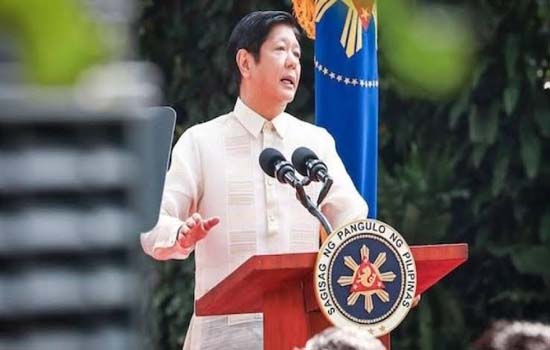
Washington : Philippine President Ferdinand Marcos Jr. is set to meet U.S. President Donald Trump this week at the White House, marking the first meeting between Trump and a Southeast Asian leader during his second term. The discussions will focus on trade and security ahead of a key August 1 deadline. Marcos aims to negotiate a more favorable trade deal for the Philippines, which faces significant tariffs from the U.S., amid ongoing challenges in securing advantageous terms compared to regional peers Vietnam and Indonesia.
The Philippines recorded a nearly $5 billion trade deficit with the U.S. last year, with Trump recently threatening to raise tariffs on Philippine imports. Southeast Asia expert Gregory Poling suggests Marcos may secure a deal with lower tariffs than Indonesia’s and Vietnam’s due to the Philippines’ close alignment with the U.S. on China-related issues.
During his Washington visit, Marcos has engaged with Defense Secretary Pete Hegseth, emphasizing the mutual defense treaty as the foundation of the bilateral relationship and its importance in maintaining stability in the South China Sea. He expressed gratitude for U.S. support amid regional threats, particularly from China.
While the Philippines seeks to strengthen its economic position to enhance its role as a key U.S. ally, trade officials are focused on achieving a “mutually beneficial” agreement. Marcos’ pivot towards the U.S. includes expanded military cooperation and increased access to military bases, especially in the context of escalating tensions with China regarding Taiwan.
The U.S. has threatened new 20% tariffs on Philippine exports starting August 1, up from a previously indicated 17%.Philippine officials describe the effort as seeking a deal that is “mutually beneficial,” aiming to soften the impact of severe tariffs and stimulate economic growth.
The U.S. ran a nearly $5 billion trade deficit with the Philippines last year, on goods amounting to approximately $23.5 billion. Gregory Poling, a Southeast Asia expert, suggests Marcos may negotiate more favorable terms than Vietnam or Indonesia due to the Philippines’ strategic partnership with the U.S.
-
This aligns with broader U.S. efforts to counter China’s influence by strengthening alliances in the Indo-Pacific.
-
Tariff avoidance is the primary goal: Marcos wants to secure a deal before August 1 to sidestep punitive duties.
-
The meeting underscores the Philippines’ evolving pivot toward the U.S., prioritizing economic support and security safeguards amid regional pressures from China.
-
Success could bolster Philippine exports, deepen investment ties, and reinforce its stance as a critical U.S. ally in the Indo-Pacific region.
-
Overall, this high-stakes diplomacy highlights Manila’s dual-pronged approach: defending economic interests and ensuring strategic security through enhanced cooperation with the U.S.
